
Field Journal – Observations Along the Lower Elwha
Date: March 14, 2026
Location: Lower Elwha River, Indian Creek, and Lake Sutherland watershed
By: Thom Worlund - Case Inlet Fishery Task Force Member
I was recently invited and attended a Saturday Field Study Meeting to observe and learn of the work that has been done to help the Elwha River heal after removal of the upper and lower dams. The lower river dam was removed in September 2011 and the upper dam was removed in August of 2014. Our work focused on the restoration resulted from the lower dam removal. It is a four mile hike to the upper river dam site and we did not have time to include this in our day of learning.
Our host was David Tye, owner of the Taynik Lodge. He is also a DFW employee who catches and releases fishes in the Elwha River and adjacent Puget Sound waters to record angler access to fish in these waters. DFW also interviews anglers to collect data of available sport fish in these waterways. This work along with the smolt record keeping that you will read about below help tell the story of the health of this River and watershed.
The narrative below will give you a feel for the work that has been needed after the dams were removed and the current health of the Elwha and other feeder creeks that make up this watershed.


Restoring a River Once Held Back
Today’s work took us along the Lower Elwha, where the landscape still carries the memory of the two dams that once blocked this river. Neither structure had a fish ladder, and after years of legal pressure to restore salmon passage, the choice became clear: build ladders or remove the dams entirely. The river won.
Standing here now, it’s hard to imagine how long the salmon were kept from their ancestral spawning grounds. The water moves freely again, and the ecosystem is slowly stitching itself back together.


A New Bridge and New Habitat
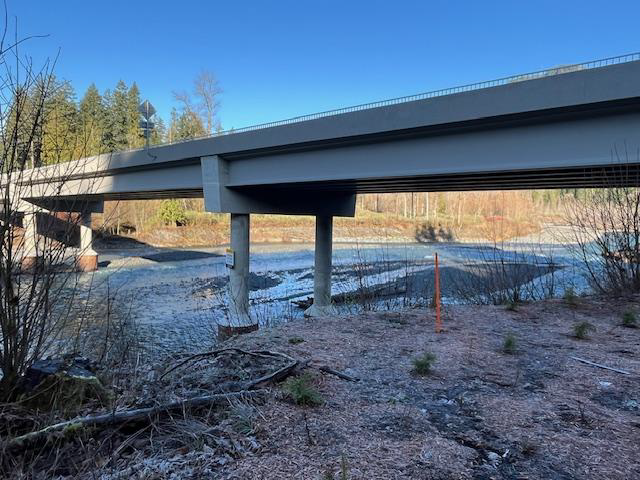
Farther up the trail, the new bridge crosses the river with a clean, modern line. Below it, clusters of woody debris have been anchored into the channel. These aren’t random piles — they’re engineered structures designed to slow the water and create pockets of calm gravel beds where salmon can spawn. Watching the current swirl around them, it’s easy to see how fish would choose these sheltered spots to lay their eggs.

Below is a photo of a river rapids just down river from the debris piles in the previous photos. This rapids was fished by David Tye who had an underwater camera and captured this shot of a steelhead resting in those rapids as he made its way back up stream. This stream bed would have been feet underwater when the lower dam was in place.


Indian Creek and the Spinning Trap
One of the most fascinating stops today was Indian Creek, where a cylindrical device spins steadily in the current. This is a smolt trap, sometimes called a “molt trap,” designed to catch juvenile fish as they migrate downstream. The trap rotates with the flow, guiding fish gently into a holding area where biologists can capture, identify, count, measure, and release them back into the creek.
Indian Creek flows into the Lower Elwha not far from the new bridge pictured earlier. About four miles upstream sits Lake Sutherland, home to Rainbow Trout and Steelhead. The trap helps estimate when different fish runs occur and how many juveniles are leaving the lake. It also occasionally catches coho and pink salmon, which tells us those species may be using the lake or its tributaries more than expected.
These traps are checked weekly by the Lower Elwha Klallam Tribe in partnership with the Department of Fish and Wildlife. Similar traps are placed on other tributaries to track how dam removal has changed fish migration patterns across the watershed.


The Team Behind the Work
Our group met Mel and Chelsea, who were helping us sort and examine the smolts collected in the trap. Chelsea works with NOAA on contract, and Mel is a tribal biologist who focuses on the tributaries of the Lower Elwha. Their teamwork is steady and practiced — measuring fish, recording data, and gently returning each one to the water. They stated that people thought that taking the dams down was the end of the work; however we have learned through these smolt traps that the real work of the healing river ecosystems is just ongoing.
A laminated life‑cycle chart nearby shows the species they encounter. Based on today’s catch, they see a surprising variety.


Species Notes - these smolts were found in the trap
● Coho Salmon
The coho are easy to spot — their bodies show faint vertical striping, especially on the juveniles. The larger fish in today’s sample was a one‑year‑old coho, already showing the sleek shape it will carry to the ocean.
● Pink Salmon
The tiny, slender fish in one of the photos is actually a pink salmon. Despite their small size at this stage, they migrate quickly and in huge numbers.
● Lamprey (Larvae)
One photo shows a lamprey larva attached to the side of a plastic observation tray. These eel‑like creatures spend years burrowed in sediment before transforming into adults.
● Rainbow Trout (Resident Form)
One fish looked like a steelhead at first glance, but Mel explained it’s actually a rainbow trout that never goes to the ocean. No one fully understands why some individuals migrate and others stay resident.


Comments